Saturday, 19 December 2009

Spiced pumpkin and potato soup

So this is what I did with the remaining third of my culinary pumpkin. It was getting towards the time of year when soup weather becomes more common so that seemed the obvious thing to make. This soup is lightly spiced with some Indian flavours and is thick and full-bodied from the vegetables. This isn't something that you need particularly accurately measurements for so everything can be scaled up or down depending on what ingredients you have and you can also increase the spicing if you want to.

Recipe (just about enough for four)

One third of a small pumpkin (peeled and chopped into small pieces)
2-3 medium potatoes (peeled and chopped into small pieces)
1/2 inch piece of ginger (peeled and crushed to a paste)
1 tbsp olive oil
2 fat cloves garlic (crushed)
1 tsp ground cumin
1 tsp ground corriander
1/2 tsp paprika
1/2 tsp ground chilli
1 pint of vegetable stock (approximately)
Salt and pepper for seasoning
Few tbsp double cream to finish

Warm the oil in a large pan and add the ginger, garlic and spices. Gently fry them for a few minutes and then put in the pumpkin and potato pieces. Stir thoroughly until all the vegetables are coated in the spice mix, and leave them to sweat slowly for around 10minutes.
Add the stock (I use Marigold vegetable bouillon powder) and leave the soup simmering for around 30mins until the pumpkin in tender. Give it a stir every now and then, and if it looks like it's becoming too dry then add some more stock or hot water. When everything is cooked through leave the soup to cool for a while and then check the seasoning. Blend with a stick blender to whatever consistency you like- I prefer my soup with a bit of texture to it rather than super-smooth. I think both the cooking method and blending got over my issues with the texture of this pumpkin that were a bit incongruous in the lasagne in my previous post. But it actually worked really well in soup, with its delicate flavour being complimented by the spices and somehow feeling quite decadent but healthy.

Gently heat the soup up whenever you want to eat it and add a bit of double cream for some extra richness. Serve with crusty bread, while gazing out over a wintery landscape.

Culinary pumpkin
I rate it 8/10 for soup making purposes
Cost: Around £0.70 for a smallish one

Monday, 14 December 2009

Deluxe spinach, mushroom and pumpkin lasagne

So here's another meal that falls into the hearty fare category. I first had a version of this veggie lasagne with butternut squash when it was made by some good friends. Obviously the memory remained strong, and a mere two years later I decided to try my hand at making the dish myself.
This was partly influenced by buying a 'culinary' pumpkin in the supermarket, that was billed as having more flavour and sweetness than a traditional carving pumpkin. And also by the ready availability of fresh pasta sheets, which I hoped would remove past issues with 'crunchy' lasagne.

Recipe (enough for a least six people)
Two thirds of a small pumpkin
Small amount of oil
Around 500g frozen spinach (defrosted)
4 large flat mushrooms
3 large cloves of garlic (crushed)
250g ricotta cheese
Nutmeg for grating
Salt and pepper for seasoning
Around 5 0r 6 sheets of fresh lasagne depending on the dimensions of your baking dish

For the cheese sauce (quantities are approximations as I usually do this by eye)
Around 30g butter
Around 30g plain flour
Around 1/4 pint of milk or enough to make a smooth sauce
Small handful grana padano cheese
Large handful cheddar cheese
Salt and pepper for seasoning

Making any lasagne is really pretty simple as it's mostly assembly but it does require preparing the components in advance.
Firstly peel and chop the pumpkin into small pieces, season, drizzle with a little olive oil, and roast in a medium oven (gas mark 6) for around 45minutes or until tender and cooked through. Set to one side to cool.
Cut the field mushrooms into thick slices and fry gently in a little oil. Add in the defrosted spinach (the same sort as used here), and the crushed garlic. When heated through mix in the ricotta cheese, season to taste and grate in some nutmeg (you want to be able to taste it but don't go overboard). Again set to one side to cool.
For the cheese sauce, simply melt the butter in a saucepan, put in the flour, stir and then gradually add in the milk. Beat like hell with a whisk to stop everything going lumpy and stop adding milk when it reaches a thin-ish sauce consistency. Keep stirring on a low heat for around 5mins to cook out the flour. Add in the cheese and then season to taste.
To put it all together I layered pumpkin and spinach, followed by a sheet of pasta, a thin layer of the cheese sauce, more pumpkin, spinach and pasta, finishing with more sauce and final sprinkling of cheddar cheese. Bake in the middle of an oven at around gas mark 6 for about 30-40 minutes or until the top of the lasagne is golden brown. To make this a 70's retro feast serve with garlic bread and salad.

This is a pretty deluxe lasagne with both ricotta and a rich cheese sauce, but the culinary pumpkin was a bit of a let down. It didn't really have much flavour and the texture was strangely watery but still fibre-y. I will be sticking to butternut squash in the future. But the fresh sheets of lasagne worked very well, with no sections left uncooked as I've experienced previously with dried pasta. I'm a fan of Quorn products as meat substitutes but have to say in this case (even with the disappointing pumpkin) the vegetables made for a much more flavoursome final product.
Thank you to A&A for the original inspiration.

Culinary pumpkin
I rate it 5/10
Cost: Around £0.70 for a smallish one

Tesco fresh lasagne sheets
I rate them 8.5/10
Cost: Around £0.80 for 6-8 sheets

PS What to do with a third of a culinary pumpkin left over from making lasagne following soon.

Monday, 7 December 2009

Rice Boat, Cambridge, UK

Despite all my gripes about the lack of non-chain dining options in Cambridge, there is one area in which the independents are going strong- and that's in the Indian restaurant sector. However the majority of these Bangladeshi operated places are generally at the cheap and cheerful end of the spectrum. And though there's nothing wrong with that, generic 'Indian' food is not something I'm particularly impressed by (possibly because I can pop home for something much nicer).

But there are exceptions to this, one of which is the Keralan restaurant Rice Boat. In the UK, 'Indian' food has tended to equate to dishes vaguely from the north of India but the south now seems to be challenging this dominance. The Rice Boat boasts authentic Keralan owners who have put together a menu with a range of south Indian favourites and some Keralan specialities. It has been a firmly established favourite of mine for some time, but as I sat down for dinner last week, I realised that I'd probably not visited it for a year or so. I'm not sure why there had been such a long gap but I hoped that my expectations which had built up over this time would not be disappointed.

And as it turned out there was no need for me to have worried as everything we ordered lived up to my memories of how good it had been on previous occasions. The menu is relatively extensive but not overblown, with lots of vegetable and seafood options (which always suits me).

Myself and the male companion person order a couple of starters to share- the squid pepper fry and and some tuna cutlets. The cutlets were dense with fish and lots of ginger, although I do still prefer my version. And in further insight into the chop/cutlet controvesy, I now think that lots of Indians consider the that the chop should be potato-based with some sort of filling inside, whereas the cutlet is a more homogeneous mix. But back to the meal- the gently sauted squid was also tasty and non-chewy, and though a bit more spice wouldn't have gone astray, they were quickly scoffed.

For mains the male companion person choose Rice Boat's 'signature dish' of Kerala red fish curry, with some coconut rice. This is identified on the menu as very spicy, and after my little taste I can attest to the accuracy of this description. But it also consisted of tender king fish and lots of other aromatic flavours behind the heat of the chillis.

I am a huge fan of the masala dosa and this is inevitably what I order whenever I get the chance. For a little variety I tried the masala dosa platter, which just adds some fried lentil dumplings or vadas on the side. For me the making of a masala dosa is the sambar and coconut chutney that are served with it. The Rice Boat dosa is irreproachable in this regard- not only was the pancake thin and crispy at the edges and packed with decent portion of cooked potatoes, the chutney was a perfect blend of fresh coconut, mustard seeds, curry leaves and whatever else they include to make it so moreish. The sambar, a soup-like hot and spicy mix of lentils and vegetables, added an ideal amount of heat to the mild filled dosa.

In terms of service my previous experiences indicate that it can be a little hit and miss, though on a quiet mid-week night it was perfectly competent with food arriving promptly but not suspiciously quickly (although the luke warm tap water was a bit of an issue).
The bill for all of the above with two beers and one non-alcoholic drink came to just under £40 (not including service), which I think is immensely good value. The overwhelming theme of all the food that I've eaten at the Rice Boat has been that it's fresh and immensely flavoursome, without ever feeling too heavy or rich. I sincerely feel that Cambridge is very lucky to have somewhere serving food like this and I hope to up my masala dosa consumption significantly in the coming year.

Rice Boat
37 Newnham Road
Cambridge CB3 9EY

Monday, 30 November 2009

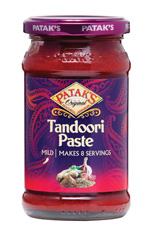
Pataks tandoori paste disappointment

So following on from the post below, here's the bit on the prawns. Not being minded to make up my own tandoori paste from scratch, I thought I'd utilise the one made by Pataks instead. I've used other pastes made by them before and have been impressed. They've always been very dense, and intensely flavoured with spices and ginger or garlic, with a thin layer of oil to keep everything well preserved. They've proved to be a very useful shortcut when marinating flavourless things like Quorn before cooking. So I thought I was on safe ground with buying a jar of Patak's tandoori paste to marinate my prawns in before grilling them.

But I probably should have exercised caution when I saw the colour of the contents of the jar. Rather than the rich, fiery red of Kashmiri chillis, this paste was more like a deep fuchsia pink. And this was with the assistance of several varieties of colouring. However my faith in Pataks remained strong and I continued with my purchase. On actually opening the jar, the 'paste' turned out to be more of a gloopy sauce, and on adding yoghurt to make the marinade the colour changed to an even more disturbing raspberry tone. I had a quick taste to check levels of spiciness and found these to be approximately none. I know that tandooris are not usually meant to be super-spicy and I am certainly no chilli-head, but this 'paste' really lacked any significant flavour. I went ahead and added some chilli to the marinade and after a couple of hours, the prawns went under a hot grill. They only took a few minutes to cook through so admittedly not much time to take on that slightly charred effect that an authentic tandoor would produce.

The taste was acceptable but definitely bland. Maybe using the product with meat (or possibly fish) and it's concurrent longer cooking times would improve the finished product, but I remain pretty skeptical. I very sincerely hope that this is a one off failure by Pataks and the rest of their proper pastes remain as good as I remember them being.

Pataks tandoori paste
I rate it 5/10
Cost: Around £1.80

Tuesday, 24 November 2009

Bengali ful kofi and North Indian saag paneer with methi

There is something about the onset of autumn and winter that makes me crave Indian food. Which is strange really as it comes from completely the opposite climate to the UK's grey and dull weather. On the menu last weekend were Bengali-style cauliflower with ginger and cumin, North Indian/Punjabi spinach with paneer and fenugreek seeds, and tandoori-style prawns. More on the prawns later, but this post focusses on the vegetables. Oh and before I forget kudos to my mother for the recipes.

So traditional Bengali Hindu cooking generally doesn't use onions or garlic when cooking vegetables, instead mostly favouring ginger and a variety of different spices. This ful kofi (cauliflower) recipe is incredibly simple and can be eaten with either rice or an Indian bread like naan or chapattis.

Recipe (enough for 2-4 depending on what else you're eating)
1 tbsp oil
1 medium cauliflower
1 dried bay leaf
1.5 tsp whole cumin seeds
1 green chilli
0.5 inch piece of ginger
About 0.5 tsp salt or enough to season

Peel and crush the ginger into a paste and fry gently in the oil for a minute or two. Add the bay leaf. Pierce the chilli a couple of times with the tip of a knife, and add to the other ingredients to achieve flavour without heat. If you do want more heat, slice the chilli up, and leave the seeds in for extra hotness. Chop the cauliflower into medium florets and add to the pan with the cumin seeds and salt. Stir everything well and cover with a lid. I like my cauliflower au naturel, but if you'd prefer some colour add a little tumeric too. This should take around 10-15minutes to cook through on a low heat, but give it a stir every now and again. If it looks like things are sticking to the pan, pour in a spoon or two of water.

The Punjab region of India is known for its fondness for all things dairy, including paneer, but the combination of green leaves with this plain 'cheese' is something that is popular across North India. If you find them you could use fresh methi leaves instead of spinach in this dish, but I much prefer cooking with the uniquely fragranced methi or fenugreek seeds. I remember my mother making paneer from scratch back in the day, a process involving cheese cloths and various stages of boiling and straining milk. Luckily (as I don't own any cheese cloths) ready made paneer is pretty widely available in supermarkets these days.

I also use frozen spinach for this recipe. It comes blanched in little blocks so it's much easier to see how much you're getting, compared to bags of the fresh stuff which always seem to shrink down to about a teaspoon's worth no matter how much you start with.

Recipe (also enough for 2-4 depending on what else you're eating)
1 block of paneer (c.225g)
1 tsp tumeric
1 tsp ground cumin
0.5 tbsp oil for frying

500g frozen chopped spinach (defrost overnight or in the microwave)
3-4 fat cloves of garlic, crushed
1.5 tsp whole methi (fenugreek) seeds
1 green chilli
0.5 tbsp oil
About 0.5 tsp salt or enough to season

Cut the paneer into smallish pieces (as in the above picture), and combine the tumeric and ground cumin. Lightly dust the paneer pieces with this coating and fry until they're slightly browned. Once this is done set the paneer to one side.
Heat the remaining oil and put the fenugreek seeds in. Stir and cook gently until they just begin to colour and then add the spinach. Also add the whole green chilli, following the same procedure as with the cauliflower dish above to adjust the amount of heat. Stir everything well and then add the crushed garlic. Cook on a low heat for around 10minutes, add the paneer back in, mix well and return to the heat for another 10minutes or so. Scoff with rice or an Indian bread, ideally with some Bengali cauliflower on the side too.

Clawson Dairy paneer
I rate it 8/10
Cost: Around £2.00 per block

Chopped frozen spinach
I rate it 8/10
Cost: Around £1.00 for 1kg

Saturday, 14 November 2009

World's simplest nectarine crumble

I can't really remember if I read this recipe in a book, saw it on television or randomly devised it myself. But it is something I have been making for quite a few years now, and is always a winner. It's one of those light puddings that's fresh enough to have during summer but also warming enough for winter. It is also incredibly quick and simple as it's essentially some baked fruit with a crushed biscuit topping.
To make the world's simplest crumble halve one nectarine per person, and scoop out the stone with a teaspoon to leave a little hollow in the middle. For the topping, melt around 1 tablespoon of butter for every two pieces of fruit and roughly crush a big handful of amaretti or ratafia biscuits. Mix these together and add a little orange juice (or another fruit juice) so that the 'crumble' topping can be lightly molded over the cut fruit, but not so much that the biscuit crumbs are totally saturated. You could also use peaches for this or apricots for mini versions, as these fruits all go well with almond flavours.
Bake in the middle of a moderately hot oven at gas mark 6, for around 15 to 20 minutes, or until the fruit is soft and the topping is starting to darken. Serve with cream or ice cream, savour the contrast of crunchy crumble and juicy, giving fruit, and start contemplating making some more!

Doria Italian ratafia biscuits
I rate them 9/10
Cost: Around £1.30 for 150g

Saturday, 7 November 2009

Japanese style noodle soup

So first the honesty declaration- my knowledge of Japanese cuisine is very limited so this recipe is completely non-authentic but does use some Japanese ingredients. It is also very quick, super-tasty and feels like it's very good for you.
The soup uses dashi stock as a base, and since the chances of me boiling some edible kelp to make my own are highly limited, I use a powder made by Shimaya. I am really not sure if this is a 'good' brand or not (it is made in Japan), but it is the only one I could find in Cambridge. It does contain MSG, which I guess is the seaweed/umami substitute, but I don't know if this is standard practice in ready-made dashi or not.
The other components of this soup are whatever you want really. I gently fried some thinly sliced garlic, mild chilli and spring onions in as little vegetable oil as possible, added a sachet of dashi stock powder and a bit less than a litre of water and brought it up to a simmer. Chinese leaf, sugar snap peas, baby sweetcorn and oyster mushrooms then went into the stock to poach for around five minutes, rapidly followed by some raw prawns and thin egg noodles. After another five minutes or so, when the prawns were cooked through, I finished the soup off with a tablespoon or so of dark soy sauce. The resulting soup was full of tender vegetables and soft noodles in a stock which is intensely savoury with a hint of chilli, and was more than enough for two hungry people.
This is a soup that can be made with any vegetables or type of noodle, with as much heat as you like, and for me it manages to tick all the comfort food boxes without being at all stodgy.

Shimaya dashi no moto stock powder
I rate it 8.5/10 (though would probably prefer an MSG-free version)
Cost: Around £1.80 for 50g box containing 5 sachets