Monday, 21 June 2010

Indian style bread and butter pudding

So I have to credit my father for the evolution of this dish. As a child I remember him making a bread and butter pudding that involved gently frying slices of white bread in butter and reducing down pints of cream with cardamom and sugar, before the whole thing was sprinkled with raisins and put in the oven. What emerged was a dense, sweet mess, and and ever since then I have found regular bread and butter puddings too dry, bland or 'eggy'. I don't think he's cooked that dish for about fifteen years but the memory must remain strong as it's the first thing I thought of when a large amount of panettone was unexpectedly presented to me some months ago.
The richness of panettone makes it an excellent substitute for plain white bread, and it even comes with it's own complement of dried fruit in it so no need to add them either. The recipe below is slightly cobbled together from what I happened to have in the fridge, but the proportions of cream and milk can be increased if you want.

Recipe (enough for 6)

Around 500g panettone, sliced
250ml double cream
250ml milk (ideally whole but I used semi-skimmed)
3 cardamom pods, lightly crushed to release the seeds
1 bay leaf
Around 50g butter
Around 3 tblsp caster sugar
1 egg yolk

Gently heat the milk and cream with the cardamom, bay leaf and initially 2 tablespoons of the sugar. Have a taste and then add more sugar as required. Leave this mix on a low heat for around 15-20mins, until it's reduced by around a quarter and thickened a little. Take it off the heat and leave to cool for a while. In the meantime beat the egg yolk thoroughly, and once the cream mix is just warm rather than hot, pour a little onto the egg. Continue to whisk well and pour on the rest of the cream. Scoop out the cardamom pods and bay leaf, and set to one side.
Melt about half of the butter in a frying pan, and when it's lightly foaming put in the panettone slices and cooked until slightly browned on both sides. Add more butter as it's needed. As the panettone is quite rich already this step might not be necessary but thought I'd stick to family tradition.
To assemble the pudding, find a dish that will hold two layers of panettone. Place slices on the bottom, overlap them a bit, and repeat for another layer on top. Pour the cream mixture over the top and push the panettone into it so that gets to soak up some of the liquid. The panettone shouldn't be floating in cream but you should be able to see some when you push the pudding down a bit. Dot a few bits of butter over the top and bake in the middle of the oven at gas mark 5 for around 25mins. The top of the pudding should be golden so cover with foil if it looks like it's scorching.
Eat with a big spoon while still a warm.


NB Some Twitter discussion revealed that this pudding might well have been influenced by another desert from the Indian sub-continent, shahi turka, which very unusually for me I had never heard of before. Anyway, here's to fusion cooking in all its forms!

Sunday, 13 June 2010

Spaghetti with broccoli, anchovy and walnuts


Broccoli dressed with anchovy is a pretty classic combination, as is pasta with garlic and anchovies- so I thought I'd combine the two into a very quick and simple dinner. The addition of the walnuts adds a slightly sweet and well, nutty, contrast to the saltiness of the fish and just seems to work very well. This is also quite a light pasta dish and so ideal for long, hot summer days (of which we've currently had two).

Recipe (enough for one)

3 large broccoli florets
4 anchovy fillets, roughly chopped
2 cloves garlic, crushed
6-8 walnuts, roughly chopped
Enough spaghetti for one, around 100g
Salt and pepper to season
Olive oil

Thinly slice the broccoli florets and gently cook in a couple of tablespoons of olive oil for around five minutes. When it's almost tender, increase the heat and add the anchovies and garlic. As the anchovies break up, drop in the walnuts and continue to cook for a couple more minutes until the garlic and broccoli are fully cooked. Cook the pasta, and mix in with the broccoli with a spoonful or two of the pasta water to loosen it all up. Season with salt (although you may not need any so taste first) and pepper, and it's done.
Ideally eat al fresco, or else staring out of the window at the rain.

Saturday, 5 June 2010

Rhubarb crumble ice cream

There are many reasons why the interweb is brilliant, and this is one of them. I would not have come across this recipe for rhubarb crumble ice cream if it wasn't for the Food Stories blog. Though it's a Delia creation it was seeing this ice cream appear on the blogosphere that prompted me to try it, and with a few handy hints via Twitter (thanks to aforkfulofspaghetti) I can declare it a huge success!

Click through using the links above for the full recipe but the beauty of this ice cream is that it is so simple. Cook rhubarb, mix with cream, add in crumble, make cold=done. As Helen Food Stories mentions I think a reduction in sugar when cooking the rhubarb is beneficial. And I should probably have reduced it even more than I did to really heighten the contrast between sweet crumble, cold cream and sharp rhubarb.

I don't have an ice cream maker so once the cooked rhubarb had cooled and been mixed with the cream, I was committed to a schedule of visits to the freezer and churning. Churning it every hour or so worked really well, though did get increasingly difficult as the ice cream become more frozen and harder to mix. Due to circumstances I churned over the course of about six hours and then left the ice cream overnight in the freezer. The next morning a full upper body work-out was required to undertake the final churn and mixing in the crumble. It then went back in the freezer for a couple of hours and was put in the fridge around half an hour before we ate it. It was definitely worth all the effort though, as the final product was delicious and ice crystal free!

Ideally serve on hot summer's day while wondering if it is worth investing in a proper ice cream maker....

Friday, 28 May 2010

Political couscous disappointment

I love couscous. I get a bit annoyed when people say it is tasteless. It's like saying pasta or potatoes are tasteless - you need to add some other nice stuff to it otherwise it is going to be bland. But despite being a long-term couscous consumer, I only came across giant or Israeli (the name seems to vary depending on political affiliations) couscous quite recently. I was rather impressed with a Tesco grilled vegetable salad that contained a mixture of regular couscous, giant couscous and chickpeas. And so I resolved to try and make my own giant couscous salad.

I used this Merchant Gourmet brand giant couscous, and was surprised to learn that you actually have to boil it like pasta rather than just pour hot water on it like the regular stuff. Although in retrospect it seems quite obvious that the larger grains would require more cooking. But once cooked I proceeded as I would normally, by dousing in olive oil and plenty of salt and pepper. I also added some finely chopped red onion, tomato, and grilled courgette.
And the outcome? Unfortunately I didn't really like it. Perhaps I over-cooked it or maybe there are other better brands I should try, but the giant couscous grains were oddly slimy, and didn't absorb flavour in the way that I'm used to with the regular variety. My salad was still perfectly edible but not really enjoyable. I think next time I will follow Tesco's example and combine this with other grains. Any other suggestions?

Merchant Gourmet giant couscous
I rate it 6.5/10

Cost: Around £2.00 for a 300g box

Saturday, 15 May 2010

Jamie's Italian, Cambridge, UK

Image from Jamie's Italian website

I was a bit unsure about reviewing Jamie's Italian as it is essentially a chain, though currently only a small one. But it's my blog so I've decided to go ahead anyway, especially because the opening of this venue was quite a big deal in a little place like Cambridge. The excitement of a new Jamie Oliver branded outlet (and it's no bookings policy) has led to long queues ever since it opened in February, and on a previous attempt to go and eat there we were given a waiting time of around two hours. We ate elsewhere.

But I was still keen to sample some of the Oliver magic, so me and the male companion person (MCP) returned a couple of weeks later. It was still packed on a week night, but at least there was no queue round the block so we were into the bar area pretty promptly with a predicted wait of forty five minutes. The Jamie's Italian in Cambridge is divided into two sections- a bar and small eating area at the front, and a much larger and rather grand dining room at the back. Somewhat randomly this is separated from the entrance by a long black curtain, giving the impression that it contains 'first class' diners who need to be hidden from the economy hordes of those merely waiting to eat.

Anyway, our wait was quite pleasant as I managed to bag us a couple of bar stools and we had some drinks and snacked on some huge green olives that were incredibly nice (as to why they were served on ice I have no idea). We'd been given a buzzer on arrival and when this went off we were escorted into the main dining room. The restaurant is located in part of Cambridge's Guildhall which used to be the tourist information centre. Jamie Oliver's team have done a great job in uncovering the large marble pillars and domed ceiling, adding some subtle lighting and turning it all into an impressive space.

And so the food. We ordered a lot and everything was acceptable if unremarkable. An antipasti dish of crispy squid and garlic aoli was disturbingly small and quite bland. My pasta starter of wild mushroom ravioli was nice enough, but probably would have been much better if it had simply arrived with fried sage leaves and parmesan (as described on the menu), rather than an attempt at a sauce with more mushrooms, chilli and tomato. The MCP's spaghetti bolognese was declared a success though, and to be honest both pasta dishes disappeared pretty rapidly.
I had the fritto misto and a green salad for my main, and the MCP went for the steamed sea bass jauntily called 'fish in bag'. My huge plate (covered in brown paper- reason unknown) contained a selection of sprats, squid, red mullet (I think), a (single) prawn, and a giant deep-fried spaghetti garnish.

The fish was all quite nicely cooked, but I do think the batter could have been lighter and seasoned more. The green salad was entirely comprised of little gem lettuce, and covered with yoghurt and parmesan cheese, and though perfectly fine I really would have preferred a simple oil and vinegar dressing. The MCP enjoyed his fish but did comment on the parsimonious quantity of the other ingredients. Two mussels and a single potato didn't seem particularly pukka. The MCP treated me to this dinner, but you can work out from the menu that the cost of our food, a couple of alcoholic drinks and a couple of non-alcoholic ones was reasonable but certainly not cheap.
But criticisms aside there are a lot of positives about Jamie's Italian. It's a fab venue, little things like the olives, and tap water on the table demonstrated some good thinking, and all the staff we encountered seemed genuinely enthusiastic about their work. But would I be prepared to wait for two hours to eat there? No.

Jamie's Italian
The Old Library
Wheeler Street
Cambridge CB2 3QJ

Thursday, 6 May 2010

Salmon salad nicoise

I was intending to write this post a couple of weeks ago. I was wearing sandals, wandering around in a floaty skirt, and keen on moving on from hearty winter fare to something a little lighter for my dinners. However summer seems to finished now, and I am back to being wrapped in a scarf. Humph.
Anyway, this is one of my favourite quick summer meals. A traditional tuna nicoise salad combines tinned tuna with boiled potatoes, salad leaves, tomato, green beans, boiled egg, anchovies and olives. This version replaces the tinned fish with some freshly grilled salmon fillets, and I've previously used fresh tuna steaks too. I omitted the tomato (realised I didn't have any) and olives (thought the anchovy would add enough saltiness), and added in some finely sliced red onion (for a bit of extra sharpness). This is not one of those recipes that requires precise amounts of ingredients so the below are really only guidelines, and you can also add in the components that I left out if you like them.

Recipe (enough for two):
2 salmon fillets, grilled, skin removed
Around 12 small new potatoes, boiled
2 eggs, boiled until hard or soft, quartered
6 anchovy fillets
1 small red onion, finely sliced
2 generous handfuls of green beans, boiled or steamed until tender
1 bag of mixed salad leaves

Dressing:
Around 6tbsp olive oil
Around 2tbsp lemon juice
Salt and pepper to taste

So simply whisk together the dressing, assemble all the above ingredients, and pour over. I like to eat this while it's still warm with the dressing being absorbed by the potatoes, and their residual heat also slightly softening the onion. But it's perfectly nice at room temperature too. Ideally serve when it's a lovely summer day.

Sunday, 25 April 2010

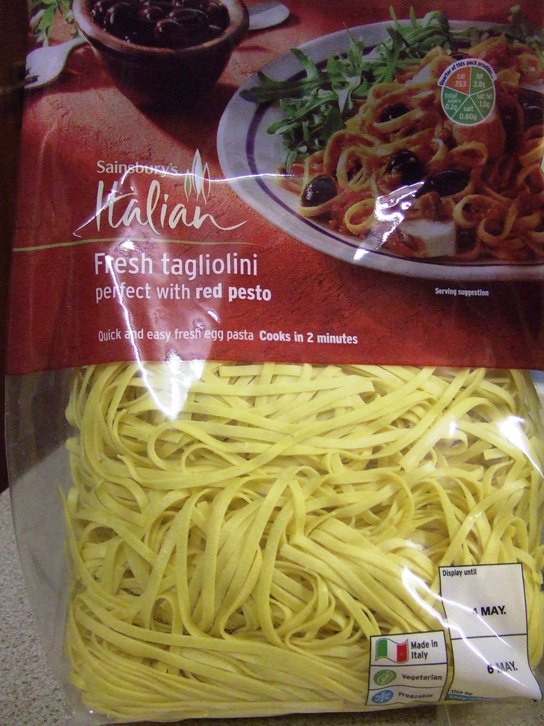
Sainsbury's fresh taglionini with rocket pesto

Shop bought pasta parcels in all shapes and sizes are often my fallback option for a quick dinner. But I think this is pretty much my only experience of fresh non-filled pasta, and I've never thought to buy a fresh alternative to my long lasting packets of dried spaghetti and linguine.
But in the spirit of trying something a bit new I picked up a bag of tagliolini from the refrigerated shelves of Sainsbury the other week. As the name seems to indicate these ribbons are a bit thinner than tagliatelle, and are enriched with egg giving the pasta a lovely yellow tinge. It's also made in Italy which probably helps those concerned with authenticity (surely our Italian brethren wouldn't send over duff pasta?).

It just needs a couple of minutes in boiling water to cook, and I served it with a simple rocket pesto. The pesto was made with this recipe, but substituting two big handfuls of rocket (around 50g) for the basil and also adding in a small chunk of grana padano or Parmesan cheese. The mellow richness of the pasta was a lovely match to the sharper flavours of the pesto. In fact I think I could have made things even simpler, and could quite easily have eaten this pasta with just a little butter or olive oil and salt and pepper.
I've never made my own pasta from scratch, and until I do I think this version from Sainsbury makes a seriously good substitute.

Sainsbury's fresh tagliolini
I rate it 8.5/10
Cost: Around £1.55 for a 500g bag